
Learning Japanese often begins with a few common words and phrases that appear in textbooks, anime, language apps and everyday conversations. Among these expressions, watashi wa meaning is one of the most searched topics by beginners. While many learners initially assume it simply means “I am,” the reality is more nuanced. Understanding this phrase correctly helps build a stronger foundation in Japanese grammar and communication.
The Japanese language relies heavily on context, sentence particles and implied meanings. Because of this, direct word-for-word translations do not always reflect how native speakers actually communicate. The phrase watashi wa serves as an excellent example. It introduces the speaker as the topic of discussion, but its function extends beyond a simple English equivalent. Learners who understand how and when to use it can communicate more naturally and avoid several common beginner mistakes.
Read Also: NWOT Meaning: What Does NWOT Mean and Why It Matters in Online Reselling
What Does Watashi Wa Mean?
To understand the phrase correctly, it helps to examine its two parts separately.
Watashi Meaning
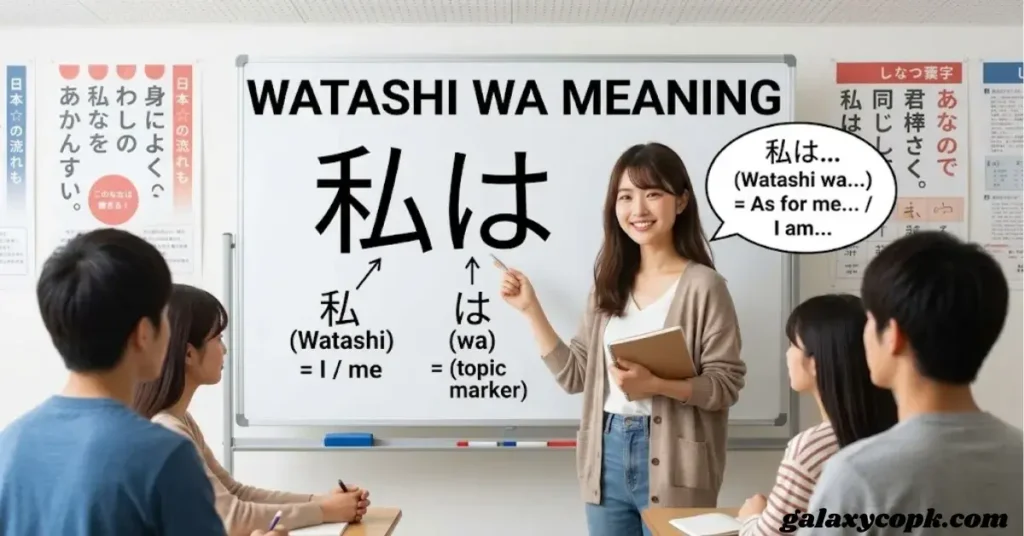
The word watashi (私) is a Japanese first-person pronoun that generally means “I” or “me.”
In modern Japanese, it is considered:
- Polite
- Widely accepted in formal situations
- Appropriate for both men and women in professional settings
- Common in introductions and public communication
When learners search for what does watashi mean, the simplest answer is that it refers to oneself. However, Japanese pronouns are used differently from English pronouns, making context extremely important.
Understanding the Particle “Wa”
The second part, wa (は), is not a separate vocabulary word. Instead, it is a grammatical particle.
Its purpose is to indicate the topic of a sentence.
Rather than saying:
“I am…”
The phrase often carries a meaning closer to:
“As for me…”
or
“Regarding me…”
This distinction may seem minor, but it reflects how Japanese sentence structure works.
Watashi Wa Meaning Together
When combined, watashi wa can be understood as:
- As for me…
- Speaking about me…
- I am…
- Regarding myself…
The exact translation depends on the rest of the sentence.
How Watashi Wa Is Commonly Used
Self-Introductions 👋
One of the earliest situations where learners encounter watashi wa is during introductions.
A speaker may begin a sentence with watashi wa before stating their name, occupation, nationality or other personal information.
This usage helps establish the speaker as the topic before additional details are provided.
Talking About Personal Preferences
The phrase is frequently used when discussing interests, hobbies or opinions.
Examples may include statements about:
- Favorite foods
- Movies
- Sports
- Travel plans
- Personal goals
Because the topic has been established, listeners immediately understand that the information relates to the speaker.
Describing Personal Information
Japanese learners also use watashi wa when discussing:
- Their profession
- Age
- Educational background
- Family situation
- Future intentions
In these situations, the phrase creates a clear and organized sentence structure.
Why Many Beginners Misunderstand Watashi Wa
Mistake 1: Assuming It Means “I Am”
A common misconception is that watashi wa directly translates to “I am.”
While that translation may work in some contexts, it is not technically accurate.
The phrase simply introduces the topic. Additional words are usually needed to complete the thought.
Mistake 2: Using It in Every Sentence
Many beginners repeat watashi wa before every statement.
Although grammatically acceptable, excessive repetition can sound unnatural.
Native Japanese speakers often rely on context and frequently omit pronouns when the subject is already obvious.
Mistake 3: Confusing “Wa” and “Ha”
Another source of confusion involves pronunciation.
The particle is written using the character は, which is normally read as “ha.”
However, when functioning as a topic marker, it is pronounced “wa.”
This unique feature often surprises new learners.
Understanding Wa Ta Shi Meaning
Some learners search for wa ta shi meaning after hearing the word spoken aloud.
The pronunciation consists of three syllables:
- Wa
- Ta
- Shi
Together they form watashi, meaning “I” or “me.”
Recognizing the pronunciation helps improve listening comprehension and speaking accuracy.
Read Also: IKTR Meaning in Text: What It Means and How People Use It Online
Alternative Ways to Say “I” in Japanese
Japanese contains several first-person pronouns, each carrying different levels of formality and social nuance.
Watashi
- Polite
- Neutral
- Suitable for most situations
Boku
- Often used by males
- Friendly and moderately casual
- Common among students and young professionals
Ore
- Very casual
- Primarily used by males
- Often heard among close friends
Watakushi Meaning
Another important variation is watakushi (私).
When learners search for watakushi meaning, they are usually encountering a highly formal version of “I.”
This expression is often used in:
- Business presentations
- Official speeches
- Customer service settings
- Formal ceremonies
Compared with watashi, watakushi sounds more refined and professional.
Cultural Importance of Omitting Watashi Wa
Context Matters in Japanese Culture 🎌
One of the biggest differences between English and Japanese communication styles is the frequent omission of subjects.
English sentences usually require explicit subjects.
Japanese, however, often leaves them unstated when context makes them obvious.
For example, after someone asks a question about a person’s occupation, the response may simply contain the occupation itself without repeating “I.”
Why Native Speakers Skip It
Japanese conversation values efficiency and contextual understanding.
Repeating information that everyone already knows can sound unnecessary.
As learners progress, they discover that natural Japanese often contains fewer pronouns than expected.
Understanding this cultural habit helps learners sound more authentic.
What Is Watashi No?
Another expression frequently encountered by beginners is watashi no.
The particle no indicates possession.
Therefore, watashi no generally means:
- My
- Mine
- Belonging to me
Examples of usage include:
- My friend
- My book
- My hometown
- My family
Understanding watashi no is an important next step after learning watashi wa because both expressions appear frequently in everyday Japanese.
Practical Situations Where Watashi Wa Appears
In Classrooms 📚
Language instructors often teach introductions using watashi wa because it provides a clear structure for beginners.
During Business Meetings 💼
Professionals may use it when introducing themselves to clients, colleagues or new business contacts.
While Traveling ✈️
Tourists learning basic Japanese commonly use the phrase to provide information about themselves.
During Language Exams 📝
Many speaking assessments evaluate a learner’s ability to introduce themselves using proper sentence patterns that often begin with watashi wa.
Tips for Using Watashi Wa Naturally
To sound more natural:
✅ Use it when introducing yourself.
✅ Use it when shifting the conversation toward yourself.
✅ Avoid repeating it in every sentence.
✅ Pay attention to context.
✅ Listen to native speakers and observe when they omit pronouns.
Following these habits can significantly improve conversational fluency.
FAQS
What does watashi mean in Japanese?
Watashi means “I” or “me.” It is a polite and commonly accepted first-person pronoun used in many formal and neutral situations.
What is the complete watashi wa meaning?
Watashi wa can be understood as “As for me,” “Regarding me,” or, depending on context, “I am.”
Is watashi wa used by both men and women?
Yes. In formal situations, it is considered gender-neutral and suitable for everyone.
What is the difference between watashi and watakushi?
Watakushi is a more formal and respectful version of watashi. It is often used in professional and ceremonial settings.
What does watashi no mean?
Watashi no means “my” or “mine” and is used to show possession.
Can a sentence consist only of watashi wa?
No. The phrase normally introduces the topic and is usually followed by additional information.
Why do Japanese speakers sometimes omit watashi wa?
Because Japanese relies heavily on context, the speaker is often understood without explicitly stating the pronoun.
Is watashi wa the same as “I am”?
Not exactly. Although it is sometimes translated that way, it functions as a topic marker rather than a direct equivalent of the English phrase “I am.”
Final Thoughts
Understanding watashi wa meaning involves much more than memorizing a translation. The phrase introduces one of the most important concepts in Japanese grammar: the idea of a sentence topic. While watashi meaning is simply “I” or “me,” adding the particle wa transforms it into a structure that frames what follows.
As learners continue studying Japanese, they soon discover that communication depends heavily on context, social situations and subtle grammatical markers. Exploring related expressions such as watakushi meaning, watashi no and other first-person pronouns further strengthens comprehension and speaking ability.