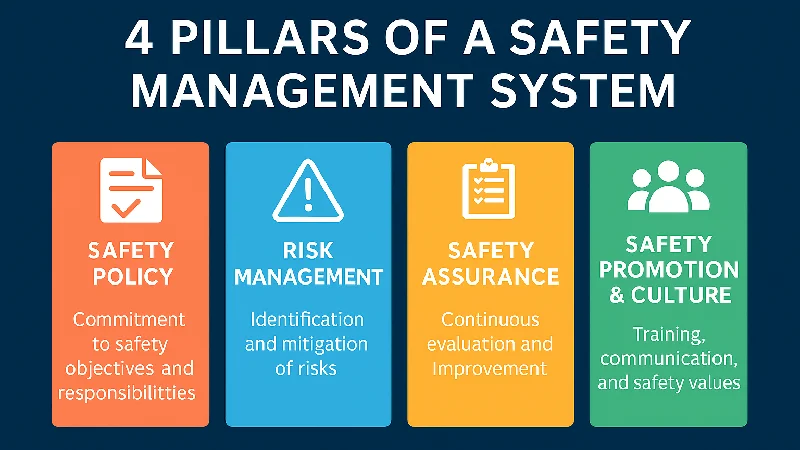

Today’s workplace safety is more than just an exercise in compliance with safety guidelines. It is now a business imperative, a factor affecting performance, retention and the overall company image on the same level as money earned and products produced. The cornerstone of this new approach to health and safety is Health and Safety Management Systems. Instead of reacting to incidents, companies can employ this system to pinpoint risks before they actually cause any trouble and manage them effectively. This is a clear-cut procedure of risk identification, control, and evaluation. In the long run, companies develop a safety culture through which safety management becomes an integral part of everyday activities, not just something to be done every year for the sake of compliance.
What Is a Health & Safety Management System?
The Health & Safety Management System is an integrated set of policies, procedures, and practices used by organizations to address occupational risks and ensure the safety of their staff from workplace-related hazards. Unlike just adhering to governmental rules and laws, a good management system is a continuous process of risk identification, assessment, control and performance review. An effective health and safety management system does not just remain a static document stored away in a filing cabinet but is integrated within the day-to-day operations of the company. An HSMS outlines responsibilities for hazard reporting, incident investigation, training program delivery and monitoring, and ensuring that the correct corrective action process is implemented. This is the reason why companies with good safety records differ from those with bad safety records despite having policies in place.
Why Every Business Needs an HSMS Regardless of its Size?
There is a common belief that health and safety management systems are needed only in industries with high risks such as construction or manufacturing sectors. This belief is quite wrong, as there are many hazards associated with office premises, warehouses, retail outlets, and even telecommuting settings. The development of formal health and safety management software makes risk assessment a systematic process as opposed to an individual judgment. Without an established process, safety measures will be reactive, meaning that safety measures are put into action only after an accident has happened. These reactive measures are very expensive, considering not only the impact they may have on people but the liability costs associated with them. Companies that take an active approach and develop a system are much more likely to be prepared to prevent accidents than to react to them.

How Does an HSMS Minimize Accidents and Liability in the Workplace?
The main advantage of a Health & Safety Management System is that it allows a company to address possible problems in advance. Through routine hazard identification and risk assessment, a company is able to identify any unsafe working conditions, dangerous equipment or behaviour before an injury is actually caused by these factors. Identification is accompanied by proper corrective actions. However, apart from the human element of injury cases at work, there are considerable financial considerations that need to be taken into account. The company may face fines, litigation, higher premiums, and losses due to work stoppage. These consequences can be minimized with the help of a properly organized approach, as it will serve as proof of due diligence that will help avoid legal and financial troubles.
What Is the Place of Employee Training in a Proper Safety Culture?
Any health and safety management system is incomplete without employee training. Training is the second most crucial factor that should be included in every such system, and it cannot be limited to initial training of newcomers only. There should be constant training depending on new regulations, equipment, or new types of incidents. HSMS software is effective in creating accountability by establishing clear responsibility for providing the necessary training, tracking completion, and ensuring competency. It is much easier to instil safe behaviour when workers understand not only the requirements but also the logic behind them, which will make them proactive when reporting potential hazards.
Why Does Documentation Management Become a Major Challenge for Health and Safety Teams?
One of the main difficulties that organizations encounter when working with the conventional model of health and safety management is that it requires a huge amount of paperwork. Incident reports, training records, inspection checklists, risk assessments, and compliance certifications can be overwhelming for a safety team using paper-based methods or spreadsheets. And this is exactly where the need for H&S management software kicks in. Using digital platforms ensures that all the necessary safety documents are collected in one place, all deadlines are tracked automatically, and the entire audit process becomes easy because you can retrieve all information instantly. The reports that would have taken days previously to compile will now be ready in minutes.
How Health & Safety Management Software Improve Your Daily Operations?
Apart from eliminating the paperwork hassle, such software makes the entire process of managing safety easier. It provides mobile options, which help your staff report any hazard or incident in real-time, directly from the field instead of reporting them when they return to the office. HSM software can improve data visibility. It means that there will be no need for guesswork; safety managers will be able to find recurring risks in the company based on the analysis of trends in different departments, locations, or time frames. This way, it will be possible to focus efforts on those places where the risk can be minimized.

What Mistakes Do Companies Commonly Make While Managing Health & Safety in the Workplace?
Many organizations with the best intentions make certain mistakes while dealing with health and safety issues. The most typical of them is the focus on safety only from the perspective of compliance requirements; in other words, the policies and programs of health and safety are aimed at satisfying auditors. Another common mistake is the inconsistency in implementation; for example, in one department the procedures are followed precisely, while in another one not so much.
Most firms underinvest in the technology they need to maintain their health and safety programs, using archaic manual methods that can hardly keep up with increased production. Without a single platform, it is almost impossible for firms to ensure consistency in different sites and shifts. Identifying such flaws early helps businesses rectify their mistakes before a major accident occurs.
Can Technology Make Health and Safety Management More Proactive Instead of Reactive?
Technology has revolutionized health and safety management at workplaces. While safety managers used to conduct inspections and record incidents periodically in the past, today’s Health & Safety Management Software makes it possible for them to monitor things and receive reports continually. It is this transition from periodic to continual supervision that makes it possible for businesses to be proactive. Alerts being automated, trails becoming digital, and use of a single dashboard allow safety managers not to wait until issues come up on their own. They are able to detect patterns, deal with underlying causes, and show improvements over time, thus improving both compliance with regulations and workplace culture.
Conclusion
The Health & Safety Management System does not exist in order to put a strain on the company’s bureaucracy. On the contrary, this is an integral part of the operations of a conscientious company, protecting its employees and securing it from liabilities and expenses. With an increasing number of operational processes, Health & Safety Management Software should be used along with the system in order to keep everything documented and managed efficiently.