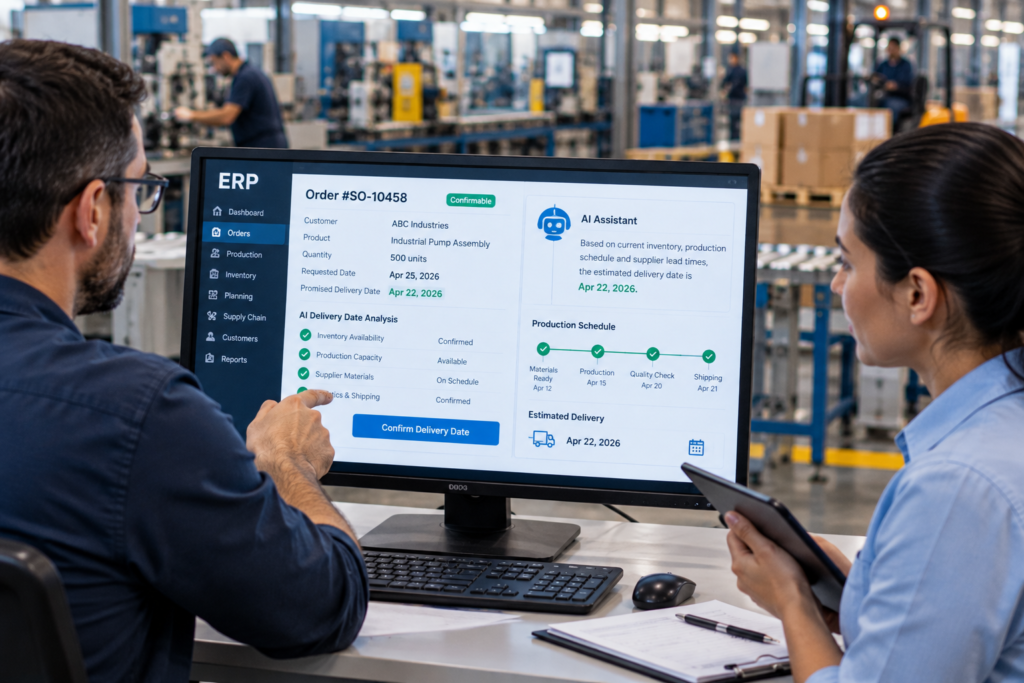

“When will my order ship?” is the question a manufacturer’s customer service team hears more than any other, and it is the one that matters most to the customer asking it. Answering it properly means checking several things: whether the material has arrived, whether the work order has been released, which line it is running on, whether the schedule is holding, and whether a carrier pickup is booked. Most service reps can get there, but only after a round of emails and calls to planning, production, and shipping. More manufacturers are now cutting that loop down to a single question typed into one screen.
Why “Where’s My Order?” Takes So Long to Answer
A reliable delivery answer depends on a current view of the order, and that view is spread across departments. Inventory knows whether components are in stock. Production knows whether the job has started and how far along it is. Planning knows whether the schedule moved yesterday. Shipping knows when the truck is coming.
In many plants, that information sits in different systems, spreadsheets, or people’s heads. A rep checks one screen, messages a planner, waits for a reply, then calls the warehouse. No single step is hard, but together they turn a simple question into an hour or more of back and forth. Meanwhile the customer is waiting, and a vague answer like “end of next week, probably” does little for their confidence.
Connect Orders, Production, and Shipping in One System
Faster answers start with everyone working from the same data. Well-configured Manufacturing ERP Software keeps sales orders, inventory, production schedules, work order progress, and shipping details linked together. When a planner moves a job to Thursday, every department sees the change. When production completes a batch, the order status updates. When the warehouse confirms a pickup, the sales order reflects it.
The benefits reach well past customer service. Planning meetings get shorter, purchasing works from real demand, and finance gets a cleaner view of what will ship and invoice this month. For the service team, it means the answer to a delivery question already exists in the system.
That data is only as good as the habits behind it. Production reported against work orders as it happens, shipments recorded when they leave the dock, and realistic due dates set at order entry are what allow the system to tell the true story of each order.
Ask in Plain Language, Get a Complete Answer
With trustworthy data in place, the next step is making it easy to reach. This is where agentic AI in manufacturing is changing daily work for service teams.
Instead of clicking through order, inventory, scheduling, and shipping screens, a rep can type a question like “What’s the status of order 8830, and what delivery date can we commit to?” The AI agent pulls the sales order, checks material availability, reviews the production schedule and current progress, and looks up the shipping plan. It comes back with a short summary: the job is scheduled for Wednesday, material is on hand, production is on track, and the earliest carrier pickup is Friday morning.
Because an agent can run a sequence of steps, it can do more than look things up. If an order is at risk, it can flag the cause, such as a late component or a capacity conflict, and list options like a partial shipment or pulling the job earlier. It can draft a clear update for the customer that the rep reviews and personalizes before sending. If a customer asks to change a quantity, it can check material and capacity, then prepare the change for the right person to approve.
Your Team Still Owns Every Customer Commitment
Customer relationships are built by people, and good reps know how to read a situation. The manufacturer decides what the agent can look up, what it can draft, and which actions need human approval. Promise dates, order changes, and customer communications stay with the team. Every lookup and draft is logged, so it is always clear which data an answer was based on.
The division of work is simple. The agent handles the information gathering. The rep handles the judgment, the empathy, and the relationship.
The Results Service Teams Report
Teams working this way usually see a few consistent changes. Delivery answers come while the customer is still on the call or within minutes of an email. Reps spend less time sending internal messages and more time with customers. Planners and production supervisors get interrupted less, because routine status questions no longer land on their desks.
Customers notice too. Fast, specific answers build trust, and a heads-up about a date change sent before the customer has to ask tends to strengthen the account rather than strain it. Reps say the job is more satisfying when they can resolve a question on the first contact.
Where to Start
List the five or six questions customers ask most often. Delivery dates, order status, shipment tracking, and quantity changes usually top the list. For each one, map the data needed to answer it and confirm that the underlying records, especially production reporting and shipment confirmations, are updated consistently.
Then pick one question type, run the agent alongside your current process for a few weeks, and collect feedback from reps on accuracy and format. Refine the answers together and add new question types once the team trusts the first one.
Faster Answers Build Stronger Customer Relationships
A manufacturer’s reputation rests on shipping good products when promised and communicating clearly when plans change. With connected ERP data and an AI agent working behind the scenes, customer service teams can answer delivery questions quickly and accurately, without chasing anyone. Customers get confidence, the plant gets fewer interruptions, and the service team gets to focus on what it does best: taking care of the people who buy from you.
About the Contributor
Nishkam Batta, Editor-in-Chief, HonestAI Magazine | AI Consultant, GrayCyan AI Solutions
Nish leads an applied AI company helping manufacturing and related companies automate operations with human-in-the-loop AI that integrates into ERPs, WMS, CRMs, and other enterprise tools, with an emphasis on explainable AI, clear audit trails, and measurable outcomes. His team builds agentic ERP systems that execute multi-step tasks inside approved guardrails so humans keep accountability, approvals, and override control.