
Introduction
In today’s digital business environment, organizations depend on technology to manage customer relationships, organize information, improve communication, and support better decision-making. Salesforce is one of the most widely recognized customer relationship management platforms, helping businesses manage sales activities, customer service, marketing campaigns, and business operations. As companies become increasingly dependent on cloud-based systems, questions about privacy, transparency, and responsible data management have become more important than ever.
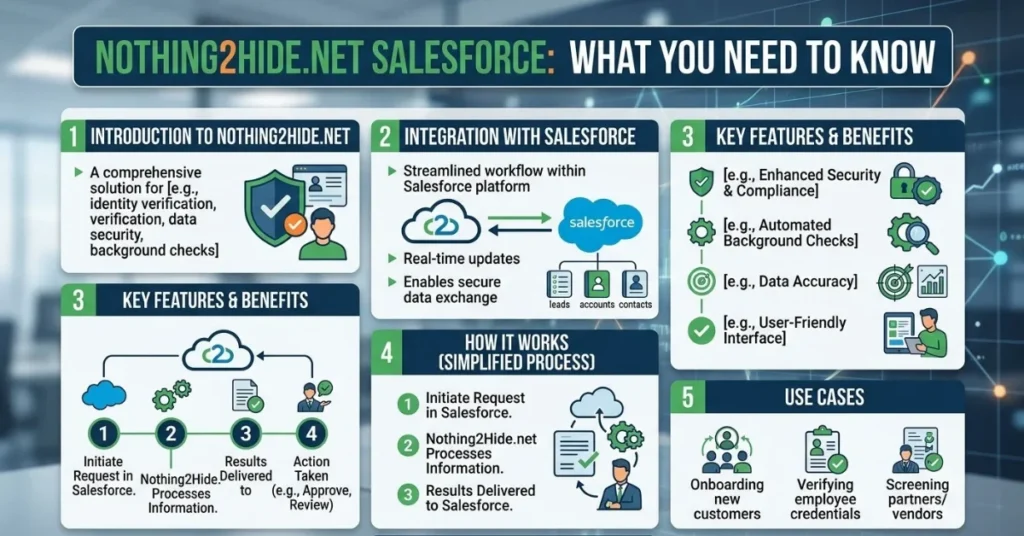
The keyword nothing2hide net salesforce brings together two ideas that attract attention in the modern technology landscape: digital transparency and Salesforce business solutions. Although the precise relationship between Nothing2Hide Net and Salesforce should not be assumed without reliable documentation, the phrase provides a useful starting point for exploring how Salesforce works, why organizations need transparent data practices, and how businesses can build customer trust.
This guide explains the potential meaning of the keyword, the main features of Salesforce, the importance of information security, and the practical considerations businesses should understand when evaluating digital platforms.
What Is Nothing2Hide Net Salesforce?
The phrase nothing2hide net salesforce appears to combine the name Nothing2Hide Net with Salesforce, a cloud-based platform designed to help organizations manage relationships with customers and business partners. Without verified information establishing a direct connection between the two names, it is important to distinguish the keyword itself from confirmed product or company information.
The words “nothing to hide” commonly suggest openness, accountability, and transparency. In a business context, these principles can mean explaining how information is collected, providing clear privacy policies, maintaining accurate records, and giving authorized people appropriate access to business information.
Salesforce, meanwhile, provides tools for managing customer information, sales pipelines, service requests, marketing activities, and other organizational processes. Businesses can configure these tools according to their operational requirements.
When considered together, the phrase nothing2hide net salesforce can serve as a topic for understanding the relationship between transparent business practices and customer relationship management technology.
However, transparency does not mean that every employee or member of the public should be able to see confidential information. Responsible transparency requires a balance between openness, privacy, and security.
Understanding Salesforce and Its Business Purpose
Salesforce is a cloud-based customer relationship management platform that helps businesses bring customer-related information and workflows into a connected environment. Rather than keeping every customer record in separate spreadsheets or disconnected applications, organizations can use Salesforce to coordinate information across teams.
For example, a sales representative may use Salesforce to record a conversation with a potential customer. A service representative can then review the relevant account information when responding to a support request, provided the organization has configured the appropriate access permissions.
This shared approach helps businesses reduce repetitive administrative work and maintain more consistent customer records.
Salesforce supports several major business functions:
- Sales management: Organizing leads, tracking opportunities, and monitoring sales progress.
- Customer service: Managing support cases, customer questions, and service workflows.
- Marketing: Coordinating campaigns, audience information, and customer engagement activities through relevant Salesforce products.
- Reporting and analytics: Reviewing business performance and identifying trends in available data.
- Automation: Reducing repetitive tasks through configured workflows and automation tools.
- Integration: Connecting Salesforce with other business applications through supported integrations and APIs.
These capabilities can be valuable to small businesses, growing companies, and large enterprises. The best configuration depends on the organization’s size, industry, budget, security requirements, and existing technology environment.
The Importance of Transparency in Customer Relationship Management
Transparency is an essential part of building lasting relationships with customers. People increasingly want to understand how companies collect, store, process, and share their personal information. Businesses that explain these practices clearly can make it easier for customers to understand what happens to their data.
In the context of nothing2hide net salesforce, transparency can be understood as a business principle rather than a verified feature of a particular website or service.
A transparent customer management system should help organizations answer several important questions. What information does the company collect? Who can access customer records? How long is information retained? What procedures are followed when a customer requests a correction or deletion?
Clear answers to these questions help organizations establish accountability. They also encourage employees to handle customer information responsibly.
Transparency should extend to internal business processes as well. Managers need reliable information about sales performance, customer service quality, and operational efficiency. When reporting systems are accurate and accessible to authorized users, teams can identify problems and make informed decisions.
Nevertheless, transparency must be implemented carefully. Publishing private customer records or exposing confidential business information would undermine trust rather than strengthen it. Effective transparency means providing appropriate visibility without compromising legitimate privacy and security requirements.
How Salesforce Supports Data Management
Salesforce offers several capabilities that organizations can use to organize customer information and manage access to sensitive records. The specific features available depend on the Salesforce products, licenses, configuration, and integrations an organization uses.
Centralized Customer Records
One of the primary benefits of a CRM platform is the ability to maintain organized customer records in a shared system. Instead of searching through multiple spreadsheets, employees can access relevant account details from a central environment when they have permission to do so.
Centralized records can improve communication between departments and reduce duplicate data entry. They can also help employees understand previous interactions before contacting a customer.
However, organizations must maintain accurate information. Duplicate accounts, outdated contact details, and inconsistent records can reduce the usefulness of a CRM system. Regular data reviews and clearly defined ownership responsibilities help address these challenges.
Access Permissions and User Roles
Not every employee needs access to every customer record. Salesforce provides security and access-control mechanisms that organizations can configure to limit what individual users can view or change.
Administrators can use permissions, profiles, permission sets, and record-level access settings to support appropriate access policies. More advanced requirements may involve additional security capabilities or products.
For example, a sales employee may need access to assigned opportunities, while a finance employee may require access to particular billing-related information. Restricting access according to legitimate business responsibilities reduces unnecessary exposure.
The principle is simple: employees should have the access they need to perform their work, but no more than necessary.
Reporting and Business Visibility
Salesforce reporting and dashboards can help managers understand how their organizations are performing. Reports may display sales activity, customer support trends, pipeline progress, or other operational measurements.
Useful reporting makes it easier to identify patterns and investigate problems. For example, a manager might discover that customer inquiries are taking longer to resolve or that a particular stage of the sales process is experiencing delays.
Reliable reporting depends on accurate data and appropriate permissions. Managers should also understand how a report is calculated before using it to make important business decisions.
Nothing2Hide Net Salesforce and the Role of Data Privacy
Data privacy is closely related to transparency, but the two concepts are not identical. Transparency explains what an organization does with information, while privacy concerns how personal information is collected, used, protected, and disclosed.
A responsible Salesforce implementation should reflect the privacy obligations that apply to the organization and its customers.
Companies should begin by identifying the types of information they collect. Basic business contact information may present different risks from sensitive personal information, financial records, or confidential communications.
After identifying the information, the organization should establish clear rules governing its use. These rules may cover data collection, employee access, retention periods, deletion requests, and sharing with third-party service providers.
Privacy policies should be understandable rather than unnecessarily complicated. Customers should be able to learn what information is collected and why it is needed.
Organizations should also evaluate their legal responsibilities. Depending on where they operate and whom they serve, applicable requirements may include data protection laws, contractual obligations, and industry-specific regulations.
Using Salesforce does not automatically make a business compliant with every applicable privacy law. Compliance requires suitable configurations, documented processes, employee training, and ongoing oversight.
Security Practices for Salesforce Users
Security is a shared responsibility involving the platform provider, organizational administrators, employees, and any relevant integration partners.
Businesses exploring the ideas associated with nothing2hide net salesforce should consider the following practices.
Use Strong Authentication
Employees should use strong, unique passwords where applicable and multifactor authentication. Multifactor authentication adds an additional verification step, helping protect accounts when passwords are compromised.
Organizations should also review account recovery procedures and remove access promptly when employees leave or change roles.
Review Permissions Regularly
Access requirements change as organizations grow. An employee who once needed broad access may no longer require it after changing departments.
Regular permission reviews help identify unnecessary privileges and reduce the risk of accidental or unauthorized data exposure. Administrators should pay particular attention to highly privileged accounts.
Monitor Activity and Investigate Unusual Behavior
Appropriate monitoring can help organizations identify suspicious login activity, unexpected data exports, or other unusual events. Available monitoring and audit capabilities depend on the Salesforce edition, configuration, and additional products in use.
Businesses should establish procedures for investigating alerts and responding to potential incidents. Monitoring should itself follow applicable privacy requirements and internal policies.
Protect Integrations and Connected Applications
Salesforce may connect with email systems, accounting software, analytics platforms, customer support tools, and other applications.
Each connection introduces configuration and access considerations. Organizations should review integration permissions, protect credentials, manage API access appropriately, and periodically evaluate connected applications.
A secure core platform cannot compensate for an insecure integration that exposes sensitive information.
Practical Benefits for Businesses
A well-managed Salesforce environment can support several business objectives.
Improved customer relationships: Employees can use relevant interaction histories to provide more consistent and personalized service.
Better operational efficiency: Automation can reduce repetitive tasks and give employees more time to focus on meaningful customer interactions.
More informed decisions: Accurate reports can help managers identify opportunities, monitor performance, and allocate resources more effectively.
Greater accountability: Defined responsibilities and appropriate audit capabilities can help organizations understand how business information is handled.
More consistent processes: Shared workflows can help departments follow agreed procedures rather than relying on informal methods.
These benefits are not automatic. Businesses must invest time in configuration, training, data quality, and ongoing system management. A poorly designed CRM environment can create confusion, unnecessary complexity, and unreliable reports.
The value of Salesforce ultimately depends on how effectively an organization aligns the platform with its actual needs.
Potential Challenges and Limitations
Although Salesforce offers extensive functionality, organizations should evaluate its limitations before implementation.
Cost and Licensing
The total cost of a Salesforce deployment can include subscriptions, implementation services, customization, integrations, training, and ongoing administration. Additional capabilities may require separate licenses or products.
Businesses should estimate their full operational costs rather than considering subscription prices alone.
Implementation Complexity
Salesforce can support sophisticated business processes, but extensive customization may increase complexity. Organizations should avoid adding unnecessary fields, workflows, and integrations simply because the platform permits them.
A clear implementation plan can help maintain usability and reduce future maintenance requirements.
Employee Training
A CRM system is only useful when employees understand how to use it correctly. Insufficient training can lead to incomplete records, inconsistent reporting, and resistance to new processes.
Training should explain both technical procedures and the business reasons behind them.
Data Quality
Moving inaccurate information into a new platform does not automatically improve it. Before migration, organizations should identify duplicates, correct obvious errors, establish consistent formats, and determine which records should be retained.
Maintaining data quality should remain an ongoing responsibility after implementation.
How to Evaluate Nothing2Hide Net Salesforce as a Search Topic
People searching for nothing2hide net salesforce may be looking for a website, a technology-related article, a service, or information about a possible connection between Nothing2Hide Net and Salesforce.
Because the exact relationship has not been established here, readers should verify the identity and purpose of any website or service before relying on its claims.
Start by examining the site’s ownership information, stated purpose, and available contact details. Look for clear explanations of its services and any documented relationship with Salesforce.
If a website claims to offer Salesforce integration, consulting, or account-related services, verify those claims independently. Check whether the provider has relevant experience and whether the claimed relationship is documented by credible sources.
Never provide Salesforce passwords, authentication codes, customer exports, or other confidential information merely because a website uses familiar technology terminology. A professional-looking website does not, by itself, establish legitimacy.
If the topic involves a third-party tool, review its privacy policy, permissions, data retention practices, and security documentation before connecting it to a business account.
These checks are useful for any unfamiliar technology service, whether or not it is associated with Salesforce.
The Future of Transparency and CRM Technology
Customer relationship management platforms are evolving alongside artificial intelligence, automation, data analytics, and increasingly sophisticated security tools.
AI-assisted capabilities can help organizations summarize customer interactions, identify patterns, and support employee productivity. However, their usefulness depends on the quality of the underlying information and the safeguards governing its use.
Businesses should evaluate whether automated systems can expose confidential information, produce inaccurate conclusions, or make decisions that require human review. Appropriate access controls, testing, monitoring, and accountability remain important.
Privacy expectations will also continue to influence how organizations design their customer management processes. Customers increasingly expect companies to communicate clearly, respect their choices, and protect information entrusted to them.
In this environment, transparency should be treated as an ongoing commitment rather than a one-time technical feature. Organizations need to review policies, improve employee awareness, evaluate security controls, and respond to changing business requirements.
Salesforce can provide tools that support these objectives, but responsible management ultimately depends on the people and processes surrounding the technology.
Conclusion
Nothing2Hide Net Salesforce is a keyword that brings together the ideas of digital transparency, customer relationship management, and responsible information handling. Although a direct relationship between Nothing2Hide Net and Salesforce has not been independently established in this guide, the topic provides a useful opportunity to examine the principles that make modern business technology more trustworthy.
Salesforce helps organizations manage customer relationships, coordinate business activities, automate workflows, and analyze performance. When configured appropriately, it can also support access control, accountability, and more organized information management.
However, technology alone cannot guarantee privacy, security, or legal compliance. Organizations must establish clear policies, maintain accurate records, review permissions, protect integrations, and train employees to handle information responsibly.
For readers researching nothing2hide net salesforce, the most important step is to distinguish verified information from assumptions. Confirm the identity of any relevant website or service, evaluate its claims carefully, and never share sensitive information without a legitimate and verified reason.
Ultimately, effective digital business management requires a balance between transparency and confidentiality. When businesses combine useful technology with responsible practices, they are better positioned to protect customer trust, improve operations, and build stronger long-term relationships.