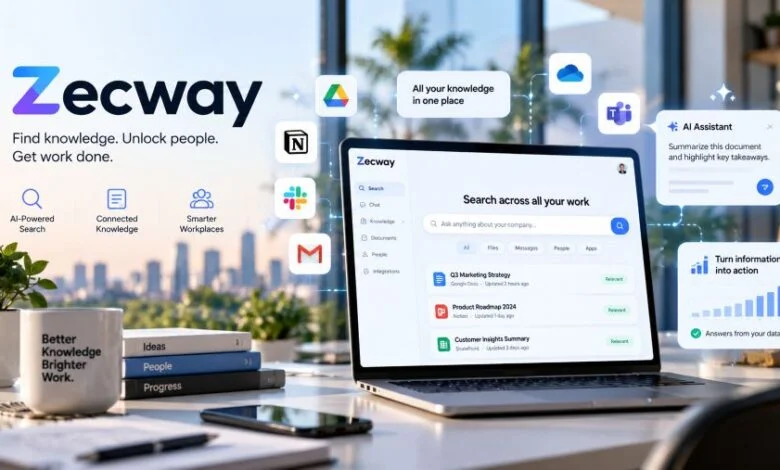

Introduction to Zecway
In the modern business world, information is one of the most valuable resources an organization possesses. Companies use email, cloud storage, messaging applications, project management platforms, and digital documents to manage their daily operations. However, as these tools multiply, finding the right information at the right time can become increasingly difficult. This is where Zecway enters the conversation as an emerging AI-powered workplace knowledge platform.
Zecway is presented as a solution designed to help businesses search for information across connected workplace applications, receive AI-generated answers supported by source references, and explore automation for repetitive tasks. Its overall goal is to make company knowledge easier to access without forcing employees to switch constantly between different software platforms.
For growing organizations, this approach could offer a practical way to improve information discovery, simplify collaboration, and reduce the effort involved in routine knowledge-based work. Nevertheless, because Zecway is an emerging platform, businesses should distinguish between its advertised capabilities and features that have been independently tested.
Understanding how Zecway works, who might benefit from it, and what to evaluate before adopting it can help readers determine whether the platform fits their needs.
What Is Zecway?
Zecway is an AI-focused workplace search and assistance platform designed to bring scattered organizational information into a more accessible experience. Rather than requiring employees to search every application individually, the platform aims to provide a central place to find relevant documents, conversations, and other available business information.
Consider a company that stores its contracts in cloud storage, discusses projects through team messaging, and manages customer communication through email. When an employee needs an answer, the necessary information may be spread across all three systems. Locating it manually can take time, particularly when the employee does not remember the exact document name or conversation.
Zecway aims to address this problem through unified search and AI-assisted responses. Its public product description also presents a broader vision that includes intelligent assistance and AI agents for completing work-related tasks.
The platform is therefore more than a traditional keyword-search concept. Its intended purpose is to help employees discover information, understand its meaning, and potentially use it to prepare practical work outputs.
However, its actual usefulness depends on the available integrations, the quality of connected information, and the reliability of its AI responses.
How Does Zecway Work?
Zecway describes its approach through three main layers: search, AI assistance, and agents. Each layer serves a different purpose in the process of turning scattered business information into useful knowledge.
1. Unified Workplace Search
The first layer focuses on finding information across supported workplace applications.
In a conventional working environment, employees may need to open multiple applications to locate a single answer. They might search a shared drive for a presentation, review messaging conversations for the latest decision, and check email for additional context.
A unified search system aims to reduce these separate steps by bringing relevant results into one experience.
For example, a marketing employee preparing a new campaign could search for the latest approved strategy, previous campaign feedback, and project deadlines. If the relevant sources are connected and accessible, a central search interface could make these materials easier to discover.
Zecway promotes this type of information retrieval as one of its core capabilities. However, users should confirm which applications are supported and whether the platform can access the specific content they need.
2. AI-Powered Answers and Assistance
The second layer moves beyond locating documents. It aims to help users understand information and transform it into useful outputs.
Instead of reading several lengthy documents, an employee might ask for a summary of a project discussion or request a draft response based on existing company policies.
An AI assistant could retrieve relevant material, organize the main points, and prepare a response that the employee can review and edit.
This approach can be valuable when employees regularly handle research, reporting, customer communication, or internal documentation. It may also help new team members understand established procedures without repeatedly asking colleagues for basic information.
Zecway emphasizes answers grounded in company knowledge and supported by citations. These references are intended to help users check where information originated.
Still, citations do not guarantee that every answer is correct. Employees should verify important details, particularly when the information involves financial decisions, legal obligations, contractual commitments, or confidential matters.
3. AI Agents and Workflow Automation
The third layer focuses on helping businesses manage more involved tasks.
According to its public presentation, Zecway aims to support AI agents that can conduct research, prepare information, and assist with recurring workflows. Some illustrated processes include a human approval step before an action is completed.
Imagine a project manager who needs a weekly summary of developments across several ongoing projects. An appropriately configured agent could potentially gather relevant information, organize updates, and prepare a report for review.
This could reduce repetitive manual work and help teams maintain a more consistent reporting process.
However, businesses should verify which agent features are currently available, which integrations they require, and whether actions can be restricted to approved tasks. Automation should support employees rather than perform sensitive operations without suitable oversight.
Key Features of Zecway
Zecway’s proposed capabilities address several common challenges in modern workplaces. Understanding these features helps explain why businesses may consider exploring the platform.
Intelligent Search Across Connected Tools
One of the main ideas behind Zecway is reducing the difficulty of searching across disconnected systems.
Employees often remember the subject of a document but not its title or storage location. Natural-language search can make this process more intuitive by allowing users to describe what they want in everyday language.
For example, an employee could look for the latest product presentation or search for a discussion explaining why a project deadline changed. If the relevant content is indexed and accessible, the platform may help locate useful results more efficiently.
The benefit depends on the quality of the search system and the availability of the underlying information. Organizations should test common workplace questions before relying on the platform for important tasks.
Source-Backed AI Responses
Another important feature is the emphasis on connecting AI-generated answers with their supporting information.
This matters because employees need more than a convincing response. They need to understand whether the answer reflects an approved policy, a recent decision, or an outdated document.
Source references can help users inspect the original material and evaluate the response themselves. This is particularly useful when several documents discuss similar subjects or when internal policies change frequently.
Even with source references, employees should remain responsible for reviewing important information before using it in business communications or decisions.
Permission-Aware Information Access
Businesses frequently store confidential information alongside ordinary project documents. Access permissions therefore play a central role in workplace knowledge management.
Zecway states that its approach is designed to respect existing access permissions when retrieving information.
If implemented effectively, this approach can help employees find relevant information without exposing records they are not authorized to view.
Organizations should nevertheless request technical details about permission enforcement, account administration, data handling, and access auditing. Marketing descriptions alone are insufficient to establish that a platform meets every company’s security requirements.
AI-Assisted Content Creation
AI assistance can also help employees prepare summaries, reports, and draft communications.
For instance, a sales representative might need to prepare a proposal using existing product information and previous customer discussions. An assistant could potentially organize the relevant information into a first draft, allowing the representative to spend more time checking details and improving the final response.
The employee remains responsible for verifying accuracy, adapting the tone, and ensuring that the finished document meets company standards.
Who Can Benefit From Zecway?
Zecway may be worth investigating for organizations that manage substantial amounts of digital information and want employees to access it more easily.
Operations employees regularly consult internal procedures, project updates, and departmental records. Centralized information discovery could help them locate the materials needed to resolve routine questions.
Sales and Customer Support
These teams often need current product information, customer history, and approved answers. Search and drafting assistance could help them prepare more consistent communications.
Marketing Departments
Marketing professionals manage campaign briefs, performance reports, creative feedback, and planning documents. Better information retrieval could simplify research and campaign preparation.zecway
Project managers need access to decisions, deadlines, progress reports, and outstanding tasks. An AI-assisted search system could help them assemble updates from multiple sources.
These examples represent potential applications rather than guaranteed results. The platform’s suitability depends on the organization’s existing software, security needs, and the features actually available.
Zecway and Traditional Workplace Search: What Is the Difference?
Traditional workplace search usually focuses on finding files, messages, and records. An AI-assisted workplace platform aims to extend that process by interpreting questions and helping users act on the information they discover.
| Area | Traditional Search | Zecway’s Proposed Approach |
|---|---|---|
| Information discovery | Searches available files or messages | Aims to search across connected workplace tools |
| User interaction | Often relies on keywords | Emphasizes natural-language questions |
| Answers | Primarily displays matching results | Aims to provide source-backed AI responses |
| Content preparation | Usually handled separately | AI assistance may help prepare drafts and summaries |
| Workflow support | Often requires separate tools | AI agents aim to support selected recurring tasks |
This comparison describes the intended approaches, not the results of an independent performance test.
Businesses should evaluate whether the additional AI capabilities solve real problems rather than assuming that a more advanced interface will automatically improve productivity.
Is Zecway Suitable for Small Businesses?
Small businesses can experience many of the same information-management problems as larger organizations. As a company grows, employees create more documents, exchange more messages, and establish increasingly complex procedures.
A small business might benefit from easier access to customer records, internal policies, product information, and project documents. If employees frequently interrupt one another to locate files or clarify decisions, a centralized knowledge system could be worth evaluating.
However, a smaller company may have fewer documents, simpler workflows, and a limited technology budget. In that situation, improving existing folder structures or using the search features already included in its software might be sufficient.
The right decision depends on the scale of the problem, the cost of the proposed solution, and the time required to configure it.
A practical evaluation should compare the platform against existing tools and identify measurable benefits before the business commits to broader adoption.
Zecway Pricing and Availability
As of October 2026, Zecway’s public website promotes an early-access program rather than presenting a comprehensive, publicly listed subscription price structure. The website’s invitation indicates that a credit card is not required to request early access.
This distinction is important because an early-access invitation does not guarantee immediate access, unrestricted use, or permanent free service.
Businesses interested in trying Zecway should confirm the following details directly with the provider:
- Whether new organizations can currently join the program.
- Which integrations and features are available during early access.
- Whether there are limits on users, connected applications, or stored information.
- What subscription plans and charges may apply in the future.
- Whether technical support and administrator tools are included.
- How customer data is handled during a trial and after account termination.
Until reliable commercial terms are available, it is difficult to make a meaningful price comparison with established workplace search products.
Security and Privacy Considerations
Security deserves particular attention whenever an AI platform connects to internal company information.
A workplace assistant may process project plans, customer correspondence, business reports, or confidential policies. Companies should understand what information the system can access and how that information is stored, processed, and protected.
Before connecting business accounts, administrators should investigate the following areas.
Data handling: Determine what data is collected, where it is processed, how long it is retained, and whether it is used to train AI models.
Access permissions: Confirm that users cannot retrieve documents or conversations outside their authorized access.
Account security: Review authentication options, administrative controls, and available audit records.
Data removal: Establish how information can be deleted when it is no longer needed or when the organization stops using the service.
Regulatory requirements: Check whether the provider’s contractual and technical arrangements meet the company’s applicable privacy and compliance obligations.
These checks are particularly important for businesses handling customer information, financial records, or other sensitive data.
Potential Challenges and Limitations of Zecway
Although the concept offers potential advantages, several factors may affect its practical value.
Dependence on Existing Information
An AI assistant cannot reliably provide information that it cannot access or retrieve. If company records are incomplete, duplicated, outdated, or poorly organized, search results may be less useful.
Businesses should therefore review their existing information systems before expecting an AI platform to resolve every knowledge-management problem.
Accuracy of Generated Answers
AI systems can misunderstand a question, overlook an important qualification, or combine information incorrectly. Source citations make verification easier but do not eliminate these risks.
Important outputs should be reviewed before they influence customer commitments, legal decisions, or financial planning.
Integration and Setup Requirements
Connecting different applications can involve permissions, configuration, administrator approval, and ongoing maintenance.
Organizations should verify that the tools they already use are supported and understand how changes to their software accounts might affect access.
Limited Public Evidence
Zecway’s public materials describe its intended capabilities, but publicly available independent evidence about large-scale deployments, measured productivity improvements, and comprehensive security testing remains limited.
This does not establish that the platform is ineffective. It means potential customers should use demonstrations, documentation, and structured trials to evaluate its actual performance.
Frequently Asked Questions About Zecway
1. What is Zecway?
Zecway is an emerging AI-powered workplace knowledge platform designed to help businesses find information across connected applications, receive AI-assisted answers, and explore task automation.
2. How does Zecway help businesses?
Its intended benefits include simplifying information discovery, reducing repetitive searches, helping employees prepare documents, and supporting selected workflows through AI assistance.
3. Does Zecway use artificial intelligence?
Yes. Its public product description emphasizes AI-assisted responses, company knowledge retrieval, and agents intended to support work-related tasks.
4. Is Zecway available for everyone?
The public website has promoted early access. Prospective users should check the current application process and availability directly with the provider.
5. Is Zecway safe for confidential information?
The company describes a permission-aware approach, but organizations should independently review security documentation, privacy terms, access controls, and data-handling practices before connecting confidential information.
6. Can Zecway replace existing business applications?
Its main proposition is to make information within connected applications easier to find and use. It should not be assumed to replace those applications or every workflow they support.
7. Is Zecway worth considering?
It may be worth evaluating for organizations that struggle to locate information across multiple workplace systems. A pilot using real business tasks can help determine whether its capabilities provide enough value to justify adoption.
Final Thoughts on Zecway
Zecway represents an emerging approach to workplace productivity that brings together information search, AI assistance, and potential workflow automation. Its central idea is straightforward: employees should be able to find relevant company knowledge without manually searching through every application they use.
For operations teams, sales professionals, marketers, and project managers, this approach could make routine information-based work easier. Source-backed answers and permission-aware retrieval are particularly relevant because organizations need both convenient access to knowledge and appropriate protection for confidential records.
However, businesses should approach Zecway with realistic expectations. Its advertised features should be verified against current availability, and its accuracy, security, integrations, and pricing should be assessed before adoption.
Ultimately, the value of Zecway will depend on how effectively it solves everyday business problems. Organizations that test the platform carefully, establish clear success criteria, and maintain human oversight will be better positioned to determine whether it deserves a place in their technology stack.