
Introduction
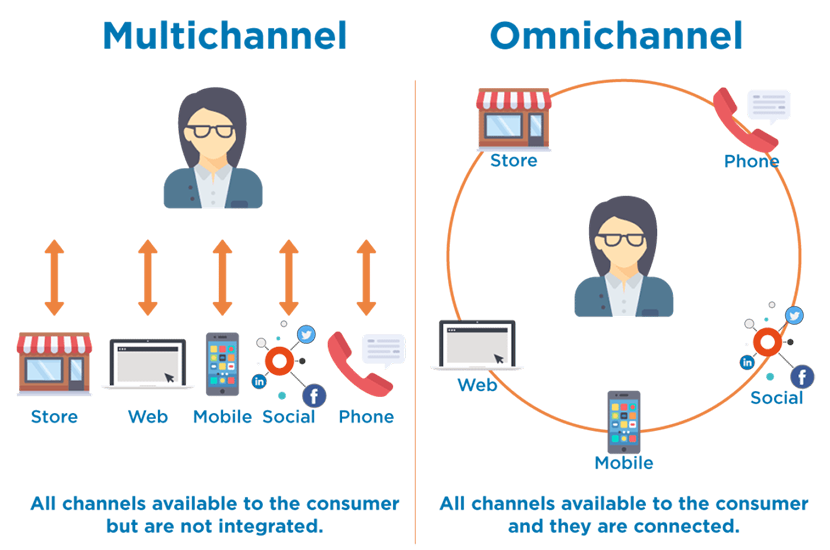
Consumers engage with brands through websites, social media sites, mobile applications, emails, brick-and-mortar stores, and other customer service platforms. Consumers expect each of these channels to be seamless with one another. That is where omnichannel marketing comes in to help firms establish consistency across different platforms.
The benefit of such an experience is that consumers do not have to repeat themselves in order to continue the process on another platform. Businesses do not see these channels as different mediums but as different pieces that need to fit together into one seamless customer journey.
How Omnichannel Marketing Connects Customer Touchpoints
The customer experience does not usually adhere to a straightforward route when dealing with a particular business in today’s time. Customers may come across a product on Instagram and then proceed to visit the website for more information about it. The customer may then be sent an email with an offer. Ultimately, the customer would purchase the product either through the mobile app or at the actual store.
When using omnichannel marketing, all these touchpoints are integrated so that the customer experience, the message, and the customer data remain aligned. Through this integration, customers find that switching from one channel to another is seamless.
Why Omnichannel Marketing Improves Customer Consistency
Consistency is one of the aspects that help create customer trust. The prices, promotions, visuals, product details, and communication of a brand have to be consistent within various channels. Contradictory information may lead to confusion and decrease customers’ trust in the company.
Omnichannel marketing allows companies to unify their communications and ensure consistency in the brand experience on different channels. Thus, a promotion that was advertised via social networks could also be found on the website and email marketing campaigns.
How Omnichannel Marketing Personalises Customer Interactions
Consumers now want their brands to know about their preferences and interests. Communication without personalization is less likely to be effective since consumers are bombarded daily with different forms of marketing communications. Personalization ensures that the interactions are personalized through the use of consumer data and interactions in the past.
Omnichannel marketing allows companies to integrate consumer interactions and available data to enhance relevance. An example would be where a consumer has engaged in a particular product category on the company’s website and then receives communications regarding that same category via email.
How Omnichannel Marketing Creates a Seamless Buying Journey
When there are no obstacles in the process of purchase journey, then there will be less friction in discovery, consideration, purchase, and after-sales support process. Customer may use one platform to do the research and other to complete the purchase process. If the shift from one stage to another is not easy, then customer might give up on the whole process.
Omni-channel marketing assists the business in connecting all these stages through the process of continuity. Elements like saved shopping cart, personalized recommendation, order tracking, and product consistency help the customer to continue the process of journey without any obstruction.
Omnichannel Marketing and the Role of Customer Data
Customer data is essential for building connected experiences. Firms may use customer data such as website interactions, purchases, email communications, mobile apps usage, social media interaction, and customer service exchanges. If this data is organized in an effective manner, then it will offer a better understanding of customer behavior.
Omnichannel marketing relies on connected customer data to facilitate better communication. Rather than analyzing individual interactions, firms may analyze the overall customer experience. At the same time, firms need to manage customer data in a responsible manner according to privacy regulations and other relevant requirements.
How Omnichannel Marketing Strengthens Brand Communication
The brand identity of a company needs to be recognizable regardless of where it is being found by the customer. Discrepancies in tone, visuals, message, or product information may result in inconsistency on behalf of the company. Effective communication coordination will ensure that there is always consistency of the brand message.
The company can achieve common messages with different content in line with each of the channels through omnichannel marketing approach. For instance, content posted on the social media platform may be shorter and visual while the email provides detailed information. Nevertheless, the message and the brand identity stay consistent.
Omnichannel Marketing and Customer Service
Customer experience doesn’t cease to exist once the transaction is complete. The customers could require assistance regarding their returns, deliveries, payments, product details, or even technical problems. If customer service processes are not integrated, then customers might be required to repeat their issue multiple times while switching from one channel to another.
The omnichannel marketing strategy can help in offering an integrated service experience by making the customer’s interactions across the digital and traditional touchpoints seamless. For example, if a customer initiates an interaction via live chat, then the business should remember the information during the transition to another service channel.
Measuring Omnichannel Marketing Performance
To ensure that a consistent customer experience is created, companies need to look at performance measurements throughout the entire customer experience journey. By focusing on channels alone, companies run the risk of overlooking important relationships that exist between customer engagements at different stages of the customer experience.
Useful metrics include customer retention, conversion ratios, repurchase ratios, engagement levels, customer satisfaction, and customer lifetime value. Companies could also look at where in the customer experience journey customers start and stop their journeys.
The Future of Omnichannel Marketing
With the development of new technologies, customer experiences are expected to become more and more connected. Technologies like artificial intelligence, automation, customer data platform, mobile technology, and analytics may be used by companies to analyze all customer interactions in different channels.
The future of omnichannel marketing will be all about developing experiences which are not only delivered through multiple channels, but are connected as well. Customers must be able to interact with the brand in the most convenient way for them and at the same time receive relevant information.
Conclusion
A consistent customer experience requires more than just being available on all platforms. Companies have to integrate their platforms, coordinate their communications, know customer journeys, and minimize friction between interactions. Only in case all the above-mentioned elements combine, customers will be able to view a brand as a single entity rather than an assortment of different platforms.
Through omnichannel marketing, companies can achieve more consistent customer journeys while also facilitating personalization, customer service, brand consistency, and data-driven decisions. As the expectations of the customers continue evolving, integration of customer journeys may prove helpful for building stronger connections with the audiences.