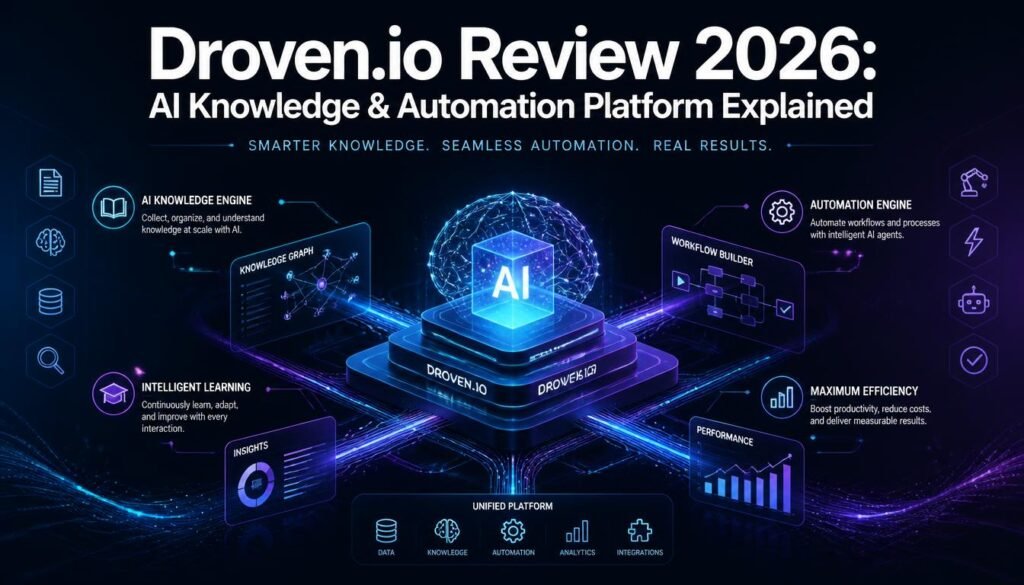

Evaluating a Droven.io Review 2026: AI Knowledge & Automation Platform Explained requires looking closely at how modern businesses manage their internal data. As companies struggle to organize fragmented information, this platform has emerged as a specialized solution for centralizing organizational knowledge. By integrating generative AI with automated workflows, it aims to reduce the time employees spend searching for documents or repeating manual tasks.
This article provides a candid look at the platform’s actual capabilities, pricing structures, and long-term utility for growing teams in 2026. You will gain clarity on whether this software fits your current operational needs or if it adds unnecessary complexity to your stack.
Core Functionality and Platform Architecture
At its heart, the software functions as a sophisticated knowledge repository that connects directly to your existing communication tools. It ingests data from sources like Slack, Google Drive, and Notion to create a unified search experience.
Unlike a static database, it uses machine learning to understand the context of your files rather than just relying on keyword matching. This distinction is critical for teams that store vast amounts of technical documentation or project history.
The automation component acts as an intermediary between your data and your daily output. When a user asks a question, the system synthesizes information from across your linked apps to provide a verified answer.
It doesn’t just point to a link; it summarizes the relevant findings into a digestible format. This effectively lowers the barrier to entry for new hires who need to get up to speed on company processes without bothering senior staff.
Evaluating the User Experience
The interface prioritizes speed and simplicity, which is a major shift from the clunky enterprise software of the past. Users interact with a clean chat-style input, similar to popular generative AI tools, but with the added security of internal data grounding.
This familiarity helps with adoption rates, as employees don’t need extensive training to start querying their own company documentation. The platform also includes a dashboard for administrators to track which topics are being queried most frequently.
However, the effectiveness of the tool depends heavily on the quality of your initial data inputs. If your source files are poorly structured or outdated, the AI will likely surface irrelevant or incorrect information.
Successful teams treat the setup process as a data hygiene project, cleaning up their repositories before connecting them to the software. Once the data is organized, the platform becomes a powerful force multiplier for productivity.
Technical Integration and Compatibility
Connecting this software to your business ecosystem is designed to be a low-friction process. It supports standard API connections for most major SaaS applications used in modern offices.
You can configure specific permissions so that sensitive documents remain restricted to certain departments, such as HR or Finance. This granular control is essential for maintaining compliance while still allowing for broad knowledge sharing.
The platform also offers webhooks that trigger actions based on specific inputs. For example, if a customer support query contains specific technical keywords, the system can automatically draft a response based on internal engineering wikis.
This bridge between knowledge management and workflow automation is where the software demonstrates its most significant value. It moves beyond simple retrieval and starts participating in the actual execution of business tasks.
Cost Analysis and Subscription Tiers
Determining the value of an investment in this technology depends on your organization’s scale. The pricing model generally follows a per-seat structure, which can get expensive for larger teams if not managed correctly.
Many businesses choose to pilot the tool with a single department such as Customer Success or Sales before rolling it out company-wide. This allows stakeholders to measure the ROI through reduced ticket volume or faster onboarding times.
See More: EuroGamersOnline The Different Types of Gamers & Gadget Archives Guide
| Plan Tier | Focus Area | Primary Value Prop |
|---|---|---|
| Starter | Small Teams | Basic search and limited integrations. |
| Professional | Scaling Businesses | Full workflow automation and advanced analytics. |
| Enterprise | Large Organizations | Custom security, dedicated support, and API access. |
When considering the costs, it is helpful to look at the time saved per employee. If each staff member saves even two hours a week on document retrieval, the subscription cost is often offset within the first quarter. You should calculate these potential savings against the monthly licensing fee to justify the expenditure.
Security and Data Privacy Standards
Handling internal business data requires a rigorous approach to security, and this platform takes several steps to ensure compliance. It uses encryption both in transit and at rest to protect sensitive information from unauthorized access.
The software also offers audit logs, which allow administrators to see exactly who accessed what information and when. For companies operating in regulated industries, these features are non-negotiable requirements.
You can learn more about the broader standards for data management by reviewing the guidelines provided by the National Institute of Standards and Technology regarding information security. By aligning your internal practices with these frameworks, you ensure that your use of third-party automation tools does not expose the company to unnecessary risks.
Always review the platform’s specific data processing agreement to understand how your information is used for model training. Most professional tiers allow you to opt out of having your data used to train the general AI models.
Common Implementation Challenges
The biggest hurdle for teams is not the software itself, but the human element of changing workflows. Employees are often accustomed to hoarding knowledge or using specific, informal channels for information.
Moving to a centralized AI platform requires a cultural shift where documentation is prioritized as a core business asset. If the team does not consistently update the wiki or project folders, the AI will eventually provide stale information.
Another challenge involves the “black box” nature of AI responses. Sometimes the system will generate an answer that sounds confident but is factually incorrect due to a hallucination.
Implementing a “human-in-the-loop” verification process for critical information is a best practice. Teams should designate a knowledge manager who periodically reviews the AI’s most common answers to ensure accuracy.
Key Benefits for Modern Businesses
The shift toward AI-driven knowledge management offers several tangible advantages for growing companies. By reducing the reliance on tribal knowledge, businesses become more resilient to staff turnover.
When a key employee leaves, their institutional knowledge remains in the system rather than walking out the door with them. This creates a stable foundation that allows for faster scaling and more consistent output.
- Faster Onboarding: New hires find answers to procedural questions instantly.
- Reduced Context Switching: Employees stay in one window instead of jumping between apps.
- Consistent Messaging: Sales and support teams use the same approved documentation.
- Operational Efficiency: Automated workflows handle routine data entry and categorization.
- Better Decision Making: Leaders have access to insights derived from internal data trends.
These benefits are most pronounced in remote-first environments where asynchronous communication is the norm. Without the ability to simply tap a colleague on the shoulder, having a digital source of truth becomes a primary requirement for success.
Frequently Asked Questions
Is the platform suitable for non-technical users?
Yes, the interface is designed for general business users, not just engineers. If a team member can use a search engine or a chat app, they can effectively use this tool to retrieve information.
Does it replace existing project management software?
No, it is intended to complement your current tools like Jira, Asana, or Trello. It connects to them to pull data, but it does not replace their core project tracking or task management features.
Can I limit what information the AI can access?
Absolutely, you have full control over the permissions. You can restrict the AI to specific folders, channels, or document types to ensure that sensitive data remains private.
What happens if the AI provides an incorrect answer?
The platform typically includes a feedback loop where users can flag incorrect or outdated answers. These flags notify administrators to update the source documentation, ensuring the system improves over time.
How does it handle data updates in real-time?
The system constantly syncs with your connected apps. When a document is updated in a source like Google Drive or Notion, the AI reflects those changes in its next response.
Final Assessment and Next Steps
A Droven.io Review 2026: AI Knowledge & Automation Platform Explained reveals a tool that is maturing alongside the needs of the modern workforce. It is not a magic solution that fixes broken internal processes, but it is a powerful catalyst for teams that are already committed to documentation and organization.
For companies struggling with information silos, the potential for efficiency gains is significant. You should approach the adoption by starting with a small, well-defined data set to prove the concept before expanding.
If you are ready to move forward, begin by auditing your current documentation health. Identify the most common questions your team asks and see if those answers exist in a clear, digital format.
Once your house is in order, the platform can act as the engine that keeps your team informed and efficient. If you have questions or specific use cases you are considering, feel free to reach out for further clarification on how this technology might fit your unique workflow.