
Digital communication has changed the way people interact with one another. From short text messages to social media comments, people often use abbreviations to express their thoughts quickly. One abbreviation you might encounter while chatting with friends or browsing social platforms is DWU. If you have received a message containing these three letters and wondered what they mean, understanding the DWU meaning can help you respond confidently.
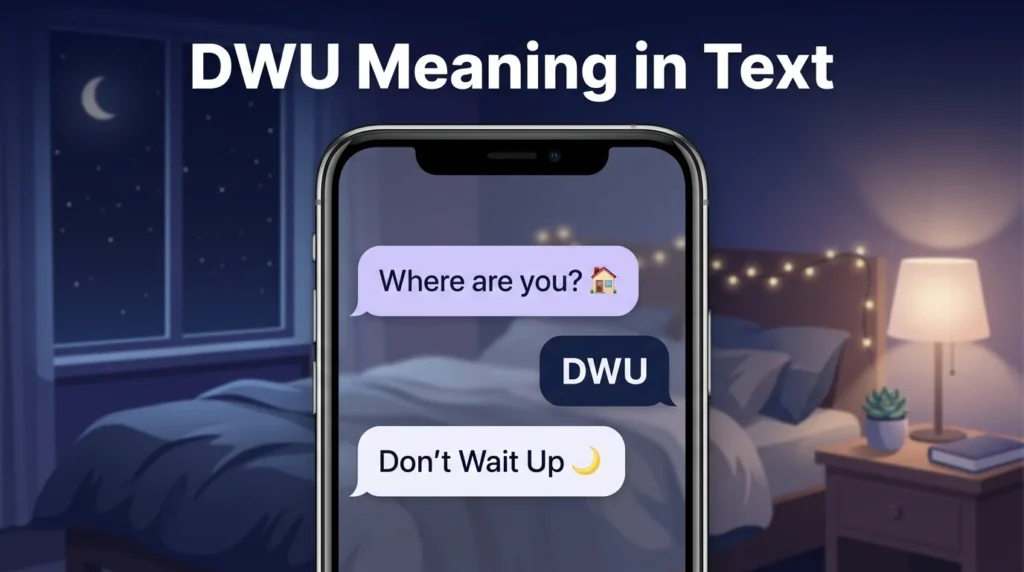
DWU commonly stands for “Don’t Wait Up” in texting. It can be used when someone wants to tell another person not to stay awake or wait for them because they expect to arrive late. However, the meaning can depend on the conversation, the relationship between the people involved, and the context in which the abbreviation appears.
In this article, we will explore the DWU meaning, how people use it in text messages, practical examples, alternative interpretations, and the best ways to respond when someone sends you this abbreviation.
What Does DWU Mean in Texting?
The most common interpretation of dwu meaning in casual messaging is “Don’t Wait Up.” People use this expression when they want to let someone know that they may return late, finish an activity later than expected, or remain unavailable for a while.
For example, imagine that your friend is attending a party and you expect them to come home early. They might send you a message saying, “DWU, I’ll probably be home late.” This means you should not stay awake or delay your plans waiting for them.
The abbreviation is particularly useful in informal conversations because it communicates a simple message using only three letters. Instead of typing the entire phrase, someone can write DWU and expect the other person to understand it.
However, abbreviations do not always have one universal meaning. In some conversations, DWU may be used differently according to personal habits, online communities, or the subject being discussed. Therefore, it is helpful to consider the surrounding words before deciding what the sender intended.
The Origin of DWU
DWU developed as part of the broader trend toward shortened language in digital communication. Before smartphones became common, people already used abbreviations in internet chat rooms, online forums, and text messages. Mobile phone messaging encouraged even shorter expressions because typing could be inconvenient and message lengths were sometimes limited.
Expressions such as “Don’t Wait Up” were naturally shortened to DWU by people who wanted to communicate quickly. Similar abbreviations include BRB, which means “Be Right Back,” and TTYL, which means “Talk To You Later.”
As social media platforms and instant messaging applications became popular, these shortened expressions spread across different age groups and online communities.
Today, people may use DWU in private messages, group chats, and casual conversations. Some users recognize it immediately, while others may need additional context to understand it. Like many internet abbreviations, its popularity and interpretation can vary between communities.
How DWU Is Used in Everyday Conversations
DWU can appear in several everyday situations. Understanding these situations makes it easier to interpret the abbreviation correctly.
1. When Someone Expects to Arrive Late
One common situation involves a person who expects to return home later than usual. They might send DWU to prevent another person from staying awake just to greet them.
For example:
Person A: “Are you coming home before midnight?”
Person B: “DWU, the meeting might run late.”
In this conversation, the sender is explaining that their return time is uncertain and that the other person should not wait up.
2. When Someone Is Going Out With Friends
People may use DWU when attending a party, meeting friends, or spending time outside their homes.
For example:
“Going out with my friends tonight. DWU!”
The message communicates that the person may not return early. Depending on their relationship, the recipient might be a family member, partner, roommate, or friend.
3. When Work or Studies Take Longer Than Expected
DWU can also appear in conversations about work responsibilities, assignments, or studying.
For example:
“I have a deadline to finish tonight, so DWU.”
Here, the sender is warning the recipient that they might be busy for an extended period. The message helps set expectations without requiring a lengthy explanation.
4. When Someone Wants to Avoid Making Promises About Timing
Sometimes people are unsure when they will finish an activity. Instead of promising to arrive at a particular time, they use DWU to let the recipient make their own plans.
For example:
“Not sure when the movie will end. DWU if you’re going to bed early.”
This communicates uncertainty and encourages the other person to continue with their evening routine.
DWU Meaning on Social Media
The abbreviation DWU may also appear on social media platforms, including Instagram, Snapchat, TikTok, and Facebook. Its meaning in these environments is generally influenced by the surrounding conversation.
On Instagram, someone might use DWU in a direct message when discussing evening plans. In a Snapchat conversation, a user could send it to explain that they will be out late. In a group chat, someone might use the abbreviation to inform everyone that they will not be available until later.
Social media encourages brief communication, making abbreviations convenient. Users often combine shortened expressions with emojis, informal spelling, and casual punctuation.
For example:
“DWU I’ll text you tomorrow.”
This message suggests that the sender does not want the recipient to stay awake waiting for them. The sleeping emoji reinforces the idea that the recipient can go to sleep.
Nevertheless, the platform alone does not determine the meaning. The actual message and the people communicating remain the most important clues.
DWU Meaning in Relationships
When DWU appears in a conversation between romantic partners, its meaning may carry additional emotional significance.
For example, one partner might write:
“I’m working late tonight, DWU”
In this situation, the sender is probably trying to be considerate by letting their partner know that they should not remain awake waiting for them.
The abbreviation does not automatically suggest a problem, dishonesty, or emotional distance. It may simply be a practical way to communicate a schedule change.
However, tone and context matter. If someone regularly sends unclear messages or frequently changes their plans, the recipient might want to ask for more information rather than making assumptions.
For instance, a simple response such as “Okay, just let me know when you’re free” keeps the conversation friendly and clear.
Good communication depends on understanding the other person’s intentions rather than interpreting every abbreviation as a hidden message.
Examples of DWU in Text Messages
The easiest way to learn the DWU meaning is to examine realistic conversations.
Example 1: Talking to a Friend
Alex: “Are you coming back soon?”
Sam: “DWU, we’re still hanging out.”
Meaning: Sam expects to remain with friends for a while and does not want Alex to wait awake.
Example 2: Talking to a Partner
Emma: “Should I stay up until you get home?”
James: “No, DWU. I’ll probably be late tonight.”
Meaning: James is telling Emma that she can go to sleep instead of waiting for him.
Example 3: A Family Conversation
Parent: “What time will you be home?”
Child: “Not sure yet. DWU, I’ll message you when I leave.”
Meaning: The person does not know their exact arrival time and is advising the parent not to stay awake waiting.
Example 4: Discussing Work
Coworker: “Are you joining the group call later?”
Colleague: “I have several things to finish. DWU if I don’t reply immediately.”
Meaning: The colleague is busy and may not respond soon. In this example, the sender is using DWU informally, although a clearer phrase such as “I might be unavailable for a while” would be more precise.
These examples demonstrate why context is important. The same abbreviation may appear in different settings, but its intended message usually becomes clearer when you read the complete conversation.
How to Respond When Someone Says DWU
Your response should depend on your relationship with the sender and the situation being discussed. In most cases, a short and friendly reply is enough.
Here are several possible responses:
“Okay, no problem!”
This is a simple response that acknowledges the message without asking unnecessary questions.
“Got it. Have a good time!”
This works well when the sender is going out with friends or attending an event.
“Okay, just text me when you get home.”
This is useful when you want to know that the person has arrived safely.
“No worries, I’ll go to sleep early.”
This response directly acknowledges the meaning of “Don’t Wait Up.”
“What time do you think you’ll be back?”
Use this response when you genuinely need to know the person’s expected arrival time.
You do not need to reply with another abbreviation. Clear, natural language is perfectly appropriate, especially if you are unsure whether the other person uses texting slang frequently.
DWU vs. Other Common Texting Abbreviations
DWU is one of many expressions used to make digital conversations faster. Learning related abbreviations can help you understand casual messages more easily.
| Abbreviation | Common meaning | Typical use |
|---|---|---|
| DWU | Don’t Wait Up | Telling someone not to stay awake waiting |
| BRB | Be Right Back | Temporarily leaving a conversation |
| TTYL | Talk To You Later | Ending a conversation temporarily |
| GTG | Got To Go | Saying that you need to leave |
| IDK | I Don’t Know | Expressing uncertainty |
| IMO | In My Opinion | Introducing a personal viewpoint |
| LMK | Let Me Know | Asking someone to provide an update |
| OMW | On My Way | Saying that you are traveling to a destination |
Although these abbreviations serve different purposes, they share one important characteristic: they make informal digital communication shorter.
Understanding them can help you follow group chats, social media conversations, and text messages without needing to search for every unfamiliar expression.
Is DWU Formal or Informal?
DWU is primarily an informal abbreviation. It is most appropriate for conversations with friends, family members, romantic partners, and people who are comfortable with casual texting language.
In professional settings, using the full phrase or a more direct explanation is usually better.
For example, instead of writing:
“DWU, I’ll finish the report late.”
You could write:
“Please don’t wait for me to finish the report. I may be working late.”
Similarly, if you are communicating with a manager or client, you might say, “I expect to finish after normal business hours, so there is no need to wait for my update.”
The best choice depends on the workplace culture and the relationship between the people involved. While some teams use abbreviations regularly, clear and professional language reduces the risk of misunderstanding.
Does DWU Have Other Meanings?
Although “Don’t Wait Up” is a common interpretation in texting, DWU can have other meanings in specific communities or specialized contexts.
For example, an organization might use DWU as an internal abbreviation, a school or business might use it in a department name, or an online community might assign it a meaning specific to its members.
This is why it is important not to assume that every appearance of DWU has the same interpretation.
If someone sends you the abbreviation in a conversation about plans, schedules, or returning home late, “Don’t Wait Up” is a reasonable interpretation. If it appears in a technical document, a workplace report, or a specialized discussion, additional context may be necessary.
When you are uncertain, asking the sender what they mean is often the quickest and most reliable solution.
Common Misunderstandings About DWU
People who are unfamiliar with texting abbreviations may misinterpret DWU in several ways.
One common mistake is assuming that every abbreviation has a single, universally accepted definition. In reality, online language changes over time, and different groups sometimes use the same letters differently.
Another mistake is interpreting the abbreviation as a sign of anger or frustration. The phrase “Don’t Wait Up” is not inherently rude. It can be a considerate way to inform someone about a late schedule.
A third misunderstanding involves assuming that DWU always means the sender does not want to spend time with the recipient. In most ordinary conversations, it communicates information about timing rather than a person’s feelings.
Finally, some readers may confuse DWU with other short forms simply because they contain similar letters. Reading the entire message, considering the topic, and checking the sender’s usual communication style can help avoid these errors.
Why Understanding Texting Slang Matters
Texting slang has become an important part of modern communication. People often exchange messages while working, studying, traveling, or completing everyday activities. Short abbreviations allow them to communicate efficiently without typing full sentences every time.
Learning expressions such as DWU can make digital conversations easier to understand, particularly when communicating with people who regularly use internet slang.
It can also prevent unnecessary confusion. Instead of interpreting a short message negatively, you can use context to understand its likely meaning and ask a question if anything remains unclear.
However, abbreviations should not replace clarity when a conversation involves important plans, safety concerns, deadlines, or professional responsibilities. In these situations, explaining your meaning directly is often the better choice.
The goal of understanding texting slang is not to memorize every abbreviation. It is to recognize common expressions, interpret them appropriately, and communicate in a way that suits the situation.
Conclusion
The DWU meaning in texting is commonly “Don’t Wait Up.” People use this abbreviation when they expect to arrive late, remain busy, or finish an activity at an uncertain time. It allows them to tell friends, family members, or partners that they do not need to stay awake waiting for them.
DWU can appear in private messages, group chats, and social media conversations. Its tone is generally casual and depends on the relationship between the sender and recipient. While the abbreviation has a common interpretation, specialized communities may use it differently, so context remains important.
If someone sends you DWU, a simple response such as “Okay, no problem” is usually sufficient. If you need more information, you can ask when they expect to return.
Ultimately, understanding DWU and similar texting abbreviations makes online communication easier, faster, and less confusing. By considering the surrounding conversation rather than relying on the letters alone, you can understand the intended message and respond naturally.