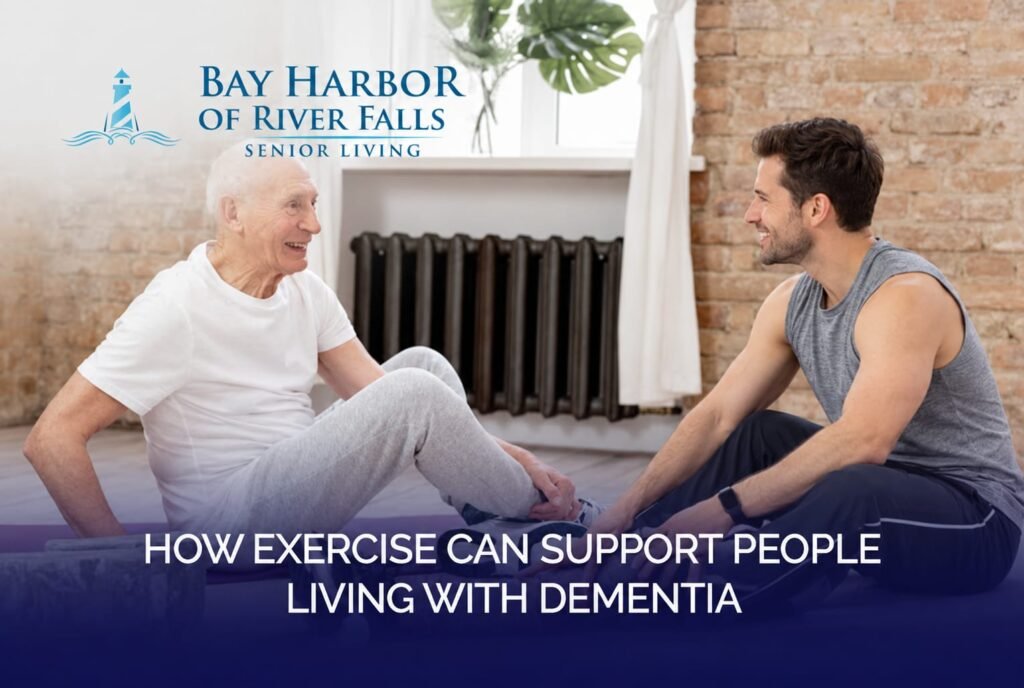

Exercise is often associated with building strength, improving cardiovascular health, or maintaining mobility. But for older adults living with dementia, regular physical activity can provide benefits that extend beyond physical fitness.
Movement can support everyday functioning, encourage social interaction, improve mood, and help older adults maintain a greater sense of independence. For people living with Alzheimer’s disease or related dementias, the National Institute on Aging notes that physical activity may improve some aspects of cognition and can also support healthy weight, sleep, and regular routines.
For families caring for someone with dementia, the goal doesn’t have to be intense exercise or a traditional workout. Simple, enjoyable, appropriately supervised movement can become part of a meaningful daily routine.
For families exploring senior living in River Falls, WI, understanding how physical activity can fit into dementia care may help when evaluating different communities and their wellness programs.
Why Is Exercise Important for People Living With Dementia?
Dementia can affect memory, thinking, communication, mobility, and the ability to complete everyday activities. As these changes progress, maintaining physical activity can become more challenging.
However, physical activity can still play an important role in daily life.
The National Institute on Aging recommends physical activity for older adults and notes that exercise can improve physical function, support daily activities, contribute to emotional well-being, and help reduce the risk of falls.
For a person living with dementia, appropriate exercise may help support several areas of daily life at the same time.
1. Exercise Can Support Mobility
Walking, gentle stretching, strength exercises, and other forms of movement can help older adults maintain physical function.
Maintaining mobility is particularly important because everyday activities often depend on strength and balance. Getting out of a chair, walking to the dining room, moving around an apartment, or participating in social activities all require some level of physical ability.
Regular movement can help older adults remain engaged in these activities for as long as possible.
Exercise should always be adapted to the person’s abilities and health condition rather than treated as a one-size-fits-all program.
2. Physical Activity Can Support Balance and Fall Prevention
Falls are a major concern among older adults, particularly for people experiencing changes in strength, balance, vision, or mobility.
NIA notes that physical activity can improve physical function and that maintaining strength and balance is important for reducing fall risk.
Exercises that safely incorporate balance, flexibility, and strength may therefore be useful components of a senior wellness program.
For someone living with dementia, supervision may be especially important if they have difficulty following instructions, become disoriented, or have an existing history of falls.
3. Exercise May Support Cognitive Function
Exercise should not be presented as a cure for dementia. Dementia is a complex group of conditions, and physical activity cannot reverse the underlying disease.
However, research suggests that physical activity may have positive associations with certain aspects of cognitive function.
NIA reports that physical activity may improve some aspects of cognition in people with Alzheimer’s disease and related dementias.
This makes movement an important part of a broader approach to healthy aging and dementia support.
The focus should be on maintaining function and quality of life rather than expecting exercise to stop dementia progression.
4. Exercise Can Improve Mood and Emotional Well-Being
Living with dementia can sometimes be frustrating or emotionally challenging. Changes in memory, communication, and independence may affect a person’s confidence and mood.
Physical activity can provide an opportunity to do something enjoyable and purposeful.
NIA notes that physical activity can support emotional and mental health, including reducing feelings of depression and anxiety and improving sleep. Exercise with other people can also provide additional social connection.
For this reason, a short walk with a friend or caregiver may offer more than physical movement. It can also provide conversation, fresh air, routine, and companionship.
5. Movement Can Support Better Sleep
Changes in sleep patterns are common among older adults, and people living with dementia may experience additional challenges with sleep and daily routines.
Regular physical activity can help support healthier sleep habits.
NIA specifically identifies improved sleep as one of the potential benefits of physical activity for older adults and notes that physical activity may also help people with dementia maintain regular sleep and toilet habits.
Exercise doesn’t necessarily need to happen for a long period. Depending on the person’s abilities, several short periods of movement throughout the day may be easier and more enjoyable than one long workout.
6. Exercise Can Encourage Independence
Independence does not necessarily mean doing everything without assistance.
For an older adult, independence may mean being able to walk to a favorite activity, choose how to spend the afternoon, participate in meals, or move around their living environment with appropriate support.
Maintaining physical function can help make these everyday experiences easier.
NIA explains that physical activity can improve functional ability, including performing daily tasks and moving around, which can support independence.
This is one reason exercise can be an important part of senior living and dementia support.
7. Exercise Can Create Social Connection
Exercise doesn’t always have to happen alone.
Group walks, gentle fitness classes, stretching sessions, dancing, or other movement-based activities can give residents opportunities to interact with others.
Social connection is especially valuable because exercise becomes more than a physical activity. It can become part of a person’s daily routine and community life.
At Bay Harbor of River Falls, the community’s wellness and life-enrichment programming includes gentle fitness, walking opportunities, and social activities. The River Falls Senior Center located within the community also offers exercise classes and other programs that encourage activity and connection.
What Types of Exercise May Be Appropriate for Someone With Dementia?
The best exercise depends on the individual’s abilities, health, interests, and stage of dementia.
There is no single exercise routine that works for everyone.
Some possibilities include:
- Walking at a comfortable pace
- Chair exercises
- Gentle stretching
- Balance exercises
- Light strength exercises
- Dancing or movement to familiar music
- Gardening or other active hobbies
- Simple recreational activities
- Group fitness classes adapted for older adults
NIA recommends a combination of aerobic, muscle-strengthening, and balance activities for older adults, with activities adapted to individual abilities and needs.
For someone living with dementia, the activity may need to be simplified. Instructions can be short and easy to follow, and familiar activities may feel more comfortable than complicated exercise routines.
Should People With Dementia Exercise Alone?
Not necessarily.
Some people with mild cognitive impairment may be able to exercise in much the same way as other older adults. However, people living with dementia may need assistance or supervision depending on their abilities and health.
NIA specifically recommends adapting physical activity and, for people with dementia who need assistance, exercising together with a caregiver can make activity easier and more enjoyable.
Supervision may be particularly important for someone who:
- Has a history of falls
- Has difficulty understanding instructions
- Becomes easily confused or disoriented
- Has significant mobility limitations
- Uses a walker or other mobility equipment
- Has other medical conditions that affect exercise safety
Before starting a new exercise routine, families should discuss the person’s individual needs with their healthcare provider.
How Can Caregivers Make Exercise More Enjoyable?
Exercise is more likely to become part of a routine when it feels enjoyable rather than like a chore.
For someone living with dementia, caregivers can consider connecting movement with activities the person already enjoys.
For example, a caregiver might play familiar music and encourage gentle movement, take a short walk after lunch, or incorporate simple stretches into a morning routine.
A few practical strategies can make physical activity easier:
Keep activities familiar: Familiar movements and environments may be less confusing.
Start small: A few minutes of activity can be a reasonable starting point for someone who is not currently active.
Use simple instructions: Demonstrating an activity may be easier than giving several verbal instructions.
Focus on enjoyment: The goal is participation and well-being rather than athletic performance.
Create a routine: Doing an activity at a consistent time can make it easier to remember.
Adapt as abilities change: An activity that works today may need to be modified later.
Exercise and Dementia: Safety Comes First
Physical activity should always be appropriate for the individual’s physical and cognitive abilities.
Older adults with dementia may have difficulty recognizing hazards or communicating discomfort. That’s why caregivers and senior living teams should pay attention to the environment, activity intensity, footwear, hydration, temperature, and signs of fatigue.
Someone with a chronic health condition may also require specific modifications.
NIA recommends talking with a doctor about an exercise plan when an older adult has a chronic condition and emphasizes starting gradually when appropriate.
The objective is not to push someone beyond their limits. It is to create safe opportunities for meaningful movement.
How Senior Living Communities Can Encourage Physical Activity
One advantage of a senior living community is that physical activity can become part of everyday community life instead of something residents have to organize entirely on their own.
A community can provide opportunities for residents to move through:
- Exercise programs
- Walking groups
- Gentle fitness classes
- Recreational activities
- Outdoor spaces
- Social events
- Daily routines that encourage movement
Bay Harbor of River Falls describes its approach as combining health and wellness programs with life-enrichment activities. Its community includes spaces for exercise, recreation, games, music, and social gatherings.
The River Falls Senior Center within Bay Harbor also offers exercise classes Monday through Thursday, along with social programming throughout the week.
This type of environment can make movement feel like a natural part of daily life rather than a separate medical task.
Exercise Should Be Part of a Bigger Approach to Dementia Care
Physical activity is valuable, but it is only one part of supporting someone living with dementia.
A comprehensive approach can also include meaningful social interaction, nutritious meals, appropriate medical care, cognitive engagement, personal routines, emotional support, and a safe living environment.
For some older adults, familiar activities and consistent routines can be particularly helpful.
The goal is to support the whole person—not simply focus on their diagnosis.
How Bay Harbor of River Falls Supports an Active Lifestyle
At Bay Harbor of River Falls, daily life is designed around comfort, connection, independence, and engagement.
The community offers independent living and assisted living, along with health and wellness programs and life-enrichment activities. Residents can participate in activities such as gentle fitness, games, creative projects, social gatherings, and community events.
The presence of the River Falls Senior Center also creates additional opportunities for exercise and social interaction within the community.
For families considering assisted living in River Falls, WI for a loved one living with dementia, it can be helpful to ask how exercise, daily activities, safety, and personalized support are incorporated into everyday life.
Frequently Asked Questions
Can exercise help people living with dementia?
Yes. Appropriate physical activity can support mobility, physical function, mood, sleep, and some aspects of cognitive function. However, exercise is not a cure for dementia and should be adapted to the individual’s abilities.
What is the best exercise for someone with dementia?
There is no single best exercise. Walking, gentle stretching, balance exercises, chair exercises, light strengthening, dancing, and other enjoyable activities may be appropriate depending on the person’s health and abilities.
Can exercise slow dementia?
Research suggests physical activity may support some aspects of cognitive function, but there is not enough evidence to say that exercise can reliably stop or reverse dementia. It should be viewed as one component of overall healthy aging and dementia care.
Should someone with dementia exercise alone?
It depends on the person’s abilities and health. Some people can exercise independently, while others may need supervision or assistance. A healthcare professional can help determine what level of support is appropriate.
How much exercise should a person with dementia get?
The appropriate amount varies. NIA recommends that older adults include aerobic, muscle-strengthening, and balance activities, but exercise should be adjusted for individual health and ability. People who are inactive can generally benefit from starting gradually.
Can group exercise benefit seniors with dementia?
Yes. Group exercise can combine physical activity with social interaction, which may make the experience more enjoyable and engaging. Senior living communities can provide structured opportunities for movement and connection.
Final Thoughts
Exercise can be a meaningful part of life for people living with dementia.
It doesn’t have to mean an intense workout or complicated fitness program. A short walk, gentle stretching, chair exercises, dancing to familiar music, or participating in a group activity can all provide opportunities for movement.
The most important considerations are safety, consistency, enjoyment, and individual ability.
When physical activity is combined with social connection, meaningful activities, personalized care, and a supportive environment, it can help older adults maintain physical function and continue participating in the routines and experiences that make daily life meaningful.
For families exploring dementia-friendly senior living in River Falls, visiting a community and asking how residents stay active, connected, and supported can be an important part of choosing the right environment.