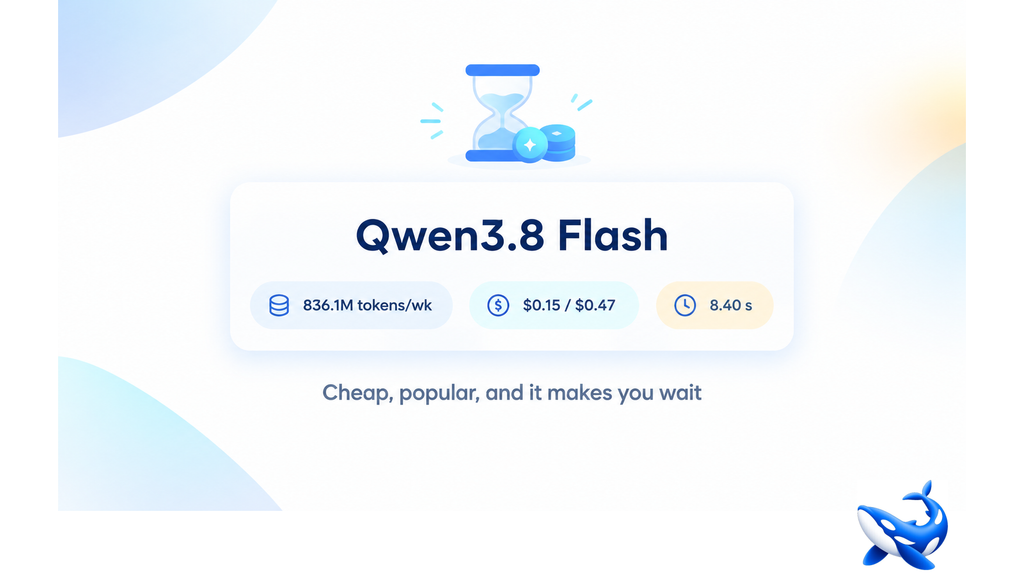

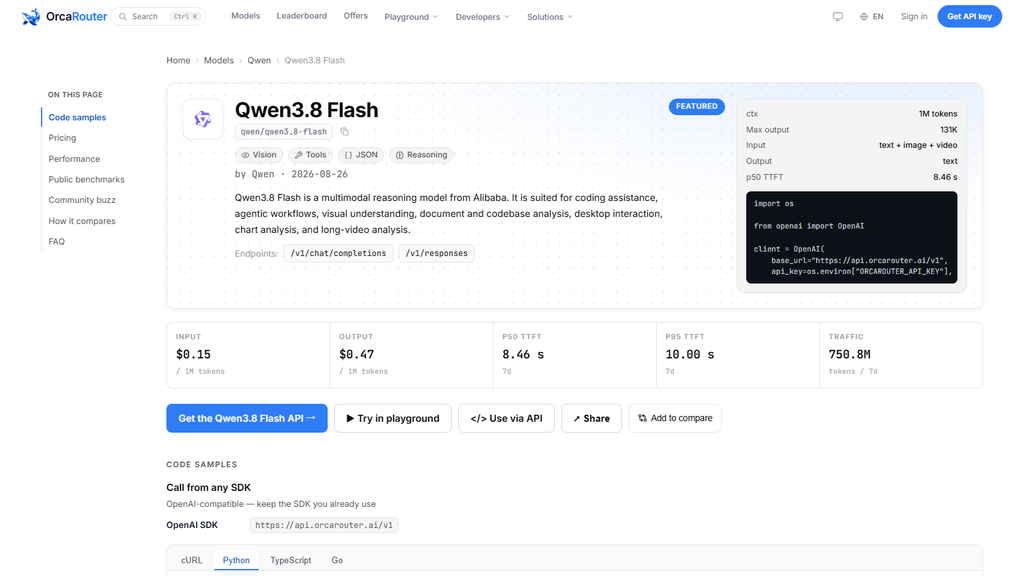
On OrcaRouter we host the Qwen3.8 Flash model — the volume rung of Qwen’s current generation, shipped on August 26, 2026, priced at $0.15 per million input tokens and $0.47 per million output, with a 1M-token context window and a 128K maximum output. It has no page on Artificial Analysis yet, the independent benchmark site that already covers the Max rung of the same family. In production its seven-day token volume is 836.1 million and its p50 time-to-first-token is 8.40 seconds. It is carried at list price on the same key as every other Qwen model, with the live telemetry on the linked page.
A card that moves 836 million tokens a week while answering its first token in over eight seconds is a card with a story to tell, and this article is about what that contradiction means.
Why 8.4 seconds has not stopped it
The p50 first token of 8.40 seconds is the slowest in its family’s current generation, and it is the first number a user feels — eight seconds of waiting before anything appears. And yet the card moves 836.1 million tokens a week. The reason both are true is that latency and throughput are different products. For batch workloads, first-token latency is nearly irrelevant: the pipeline queues a hundred thousand jobs and waits once, and the per-token economics of the card decide the total. The market has clearly run that arithmetic and found the waiting worth the price.
The other half of the story is the price itself. At $0.15 / $0.47, Qwen3.8 Flash is among the cheapest cards of its generation, and cheap cards get pointed at every workload that does not need a ceiling. That is the honest reading of the traffic: not that the latency is forgiven, but that for the volume it carries, the latency never mattered.
The Flash rung without a scorecard
| model | context | input / output | AA index | 7-day tokens | p50 TTFT |
| Qwen3.8 Flash | 1M | $0.15 / $0.47 | no page on AA | 836.1M | 8.40 s |
| Qwen3.8 Max (0902) | 1M (AA: 984K) | $2 / $6 | 45 | 64.4M | 3.12 s |
| Qwen3.7 Flash | 1M | $0.03 / $0.13 | no page on AA | 746.3M | 3.83 s |
Context windows and rate cards are what Qwen lists; the one independent score in the table belongs to the Max rung; the token volumes and TTFT figures are production telemetry from the linked pages. The table makes the family’s split visible: the Flash rung carries the traffic and the Max rung carries the score, and the gap between them is the gap between volume work and ceiling work. The Flash card’s empty scorecard column is honest about the record — no independent reading exists for it yet — so the only numbers this article will stand behind for this card are the vendor’s and ours.
The arithmetic of a batch card
The correct frame for 836.1 million tokens a week is batch throughput. A workload of a hundred thousand generation jobs at roughly 500 output tokens each is fifty million tokens; Qwen3.8 Flash can run that whole sweep for about $24 at list output price, and it will get there — slowly per job, but at a per-token cost that makes the waiting a footnote. The card’s design is legible in exactly this arithmetic: cheap per token, patient per job, and priced for pipelines that queue rather than chat.
The discipline the card demands is the discipline of matching the tool to the wait. A user-facing chat or agent that makes its human sit through eight seconds of pre-answer silence on every turn is a product decision most teams will regret. The same card running a nightly batch is an excellent deal. The traffic number says the market already knows this split and is acting on it — the wait-tolerant workloads dominate the volume, and the interactive ones are not coming to this card in numbers that matter.
The 8.40-second figure deserves one more honest look before it becomes a verdict, because first-token latency at this card’s scale is partly a load question. A card carrying 836.1 million tokens a week — the most in its family — is, by definition, the busiest endpoint of the generation, and a p50 that includes queued jobs during peak hours reads slower than the same model under light load. That does not excuse the number or make it a lie; it explains the shape of it. The buyer should still treat 8.40 seconds as the honest working figure for a busy card, while noting that the same endpoint under load is the one the market chose to put its volume on.
When cheap is the whole argument
For the workloads that dominate its traffic, Qwen3.8 Flash is not a compromise — it is the right endpoint. Extraction over a large corpus, batch rewriting, first-pass summarization, pre-generation for catalogs and drafts: each is latency-tolerant, volume-shaped and price-sensitive, and each fits this card’s profile precisely. The absence of an independent scorecard leaves the quality question formally open, but 836.1 million weekly tokens is the market’s own running answer, and it has been voting with volume.
The honest boundary is the interactive one. The same eight-second first token that makes the card a batch bargain makes it a chat liability, and the discipline is to keep it out of anything where a human waits. Everything else — the volume, the cheap input, the 1M window — points the same way: this is a card built to be queued, and the linked page shows the telemetry that proves it runs exactly that way.
The takeaway
Qwen3.8 Flash is the volume rung of Qwen’s current generation: $0.15 / $0.47, a 1M context window, a 128K maximum output, and 836.1 million weekly tokens that make it the most-called card in its family. Its p50 first token of 8.40 seconds is the honest price of that volume — the slowest in the generation, and a non-starter for interactive work. It has no page on Artificial Analysis yet, so no independent score is cited here. If your workload is a batch, a queue or a pipeline that can wait once and then run cheap, this card is built exactly for you — live at list price, with the telemetry on the linked page.
Sourcing note: release date, context window and rate card are what Qwen lists and have not been independently reproduced. Qwen3.8 Flash has no page on Artificial Analysis as of 2026-10-08, so no independent index score is cited; the Max rung’s 45 reading is from Artificial Analysis’ live page, read 2026-10-08. The p50 time-to-first-token and seven-day token volume are OrcaRouter production telemetry from the linked model page. All checked 2026-10-08.